
» ГЛАВНАЯ > К содержанию номера
» Все публикации автора
Журнал научных публикаций
«Наука через призму времени»
Сентябрь, 2025 / Международный научный журнал
«Наука через призму времени» №9 (102) 2025
Автор: Shulakova Oksana Vasilevna, a speech therapist
Рубрика: Психологические науки
Название статьи: A child and tv
Дата публикации: 12.09.2025
скачать
UDC 159.93
A
CHILD AND TV
O.V.
Shulakova, a speech therapist
Speech
Academy
Russia,
Belgorod city
Abstract. The article is devoted to the study of the impact of
television on children. The effect on human physiology is described. The consequences
of watching TV shows are noted. Parents can find answers to their questions.
You can find tips on how to replace watching TV.
Key words: television, television, child, speech, development.
Talking to parents about poor school performance, you often think of the
impact of television on a child’s mind. Adolescents can watch several films a day as
well as young children can spend several hours a day watching cartoons. Both adolescents
and young children struggle to tear themselves away from watching. Must we
really accept it because of the development of modern technologies? Perhaps
it’s high time to sound the alarm. The results of total dictations show falling
literacy rates and children’s school essays demonstrate that they can’t express
their thoughts. It’s wrong to search for a reason for these circumstances in
watching TV, there are many other reasons that have the impact on children. But
the main factor of developmental deviation of children is immoderate use of
means of technical progress. It’s impossible to eliminate all the comforts of
humanity because many of them are useful. That’s why it’s necessary to educate
children how to treat entertainment content.
Television gives an opportunity to observe world life. That’s the
opinion of the most audience. Here we have news, economics, politics. But in
most cases, they are entertainment programs, which reduce not only
intelligence, but also the spiritual development of our society. We, parents, don’t
think about the impact of television on neuromuscular and sensory processes of a child. Also, television has the
impact on biochemical and endocrine processes. It’s important not to forget
that vision is an active process in
which the muscles must tense up to perceive the image being transmitted. If we
look at a motionless
picture, we can examine this object. When the picture changes quickly, the muscles have to contract very
quickly, and they become overstrained. A person can’t realize how quickly the muscles contract. The picture on the screen consists of dots, that’s
why our eyes can’t focus properly. As our eye can distinguish much finer details, and the TV screen
presents a blurry image, far from the resolving power of the eye, then the
retina degrades. In
natural conditions, changes in the
brightness of objects are up to 180 dB. On the TV
screen, due to the peculiarities of phosphor excitation, the range of
brightness changes is no more than 60 dB, which leads to eye fatigue. The
picture of the screen isn’t stable, it constantly blinks and flickers. It leads
to both eye strain and nervous system overstrain and,
as a result, people have visual impairment. To catch the reduce of eye activity
during watching TV, you need to observe the changing size of the pupils that means that our brain
works very active. If the gaze “freezes”, then the body also falls into this
numbness.
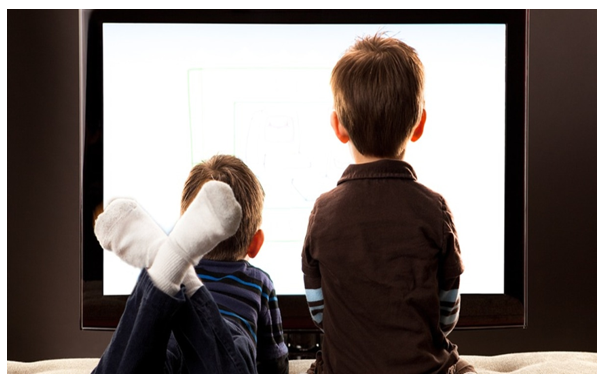
Picture 1. Watching TV for children is
like a hypnotic state
According to one of research that took place in 1970 and was done by Herbert E. Krugman, when a person was watching TV, beta
frequencies (14–30 Hz) disappeared, but alpha
frequencies (8–13 Hz) dominated. Researchers supposed that the domination
of alpha frequencies was a sign of the decline of visual attention.
Gamma waves are
the fastest. They are generated in both hemispheres
of the brain and reflect peak activity of consciousness. It is considered that
our brain generates gamma waves when people need to work with different types
of information simultaneously and link that types of
information together very quickly. A small amount of gamma waves leads
to a reduction
in the ability to remember things. Beta waves are generated by the left hemisphere
of our brain and take responsibility for solving our problems, logical
thinking, concentration, decision making. These waves allow us to be active in
society daily. Beta waves
are
the
material
world
and
our
consciousness.
The amount of beta waves increases when a person works with material world and
during communication, education and restless and anxious states. Beta
waves make the work of our brain faster, increase the
processing and assimilation of information, raise the overall energy level of
the body, sharpen the senses, excite the nervous system and relieve drowsiness.
Beta rhythm is the fastest. Beta waves can help to
accelerate the brainwork, increasing the ability to fast thinking, generation
of new ideas and, in general, stimulating a constant style
of life in a highly functional state. Beta waves help to accelerate mental
processes in work and study. Nearly one hundred years ago, Hans
Berger, a German professor of psychology, studying electrical
activity of the human brain, was the first to discover weak oscillations with a
frequency of 7-12 Hz and named them alpha waves. When your brain works in an
alpha rhythm, you enter a state of hypnotic trance, which can also be achieved with
the help of meditation or induced through hypnosis. Scientists found out that
when a person is in a state of hypnotic trance, the rhythm of brain functioning
reduces on the physiological level up to alpha level. This state is like a hypnotic
state, and it is impossible to resist it. And that is true because an EEG shows
the same symptoms as symptoms during watching TV. This state concerns not only consciousness
but also metabolism in general. The consequence of this process is children’s
and adolescents’ obesity.
There is a conclusion that children under four years old mustn’t watch TV.
Considering the visual perception process, watching TV should be forbidden,
even if they watch kind programs. Hans Jürgen Scheurle,
a physiologist, says: “The brain of a newborn is already nearly completely formed,
but functionally not developed yet. The final number of nerve cells is almost
reached. But the nerve endings and their physiological nerve connections,
synapses, are still in infancy, and they develop during life. The growth of
brain mass after birth is based almost exclusively on the growth of these
neural connections, which determine the final weight of the brain.” That
means
that
it
is
necessary
to
use
time
when
the brain is more flexible, i.e. childhood, for formation
of new nerve branches, because missed phases of formation of certain vital
functions may be impossible in the future. In childhood it is better to develop
the child's fine motor skills, sense of balance, strengthen the vestibular
apparatus. All that
develop
the body up to maturity in the current
conditions of life. Sometimes all
these
life
conditions
are
convenient
and comfortable, but they restrict space for children’s games. And
that
leads
to
movement
deficit.
Nursery rhymes play a special role in the
development of children at early preschool age: the sound flow of speech has an
activating effect. Simple rhyme, repeated words, exclamations and emotional
appeal involuntarily make the child listen and repeat the words. Repeated sound
combinations, words, their melodiousness create the effect of musicality. With
their help, the child’s speech, hearing and pronunciation of sounds develop are
developed with the help of
nursery
rhymes. Also, modern children lack the emotional-tactile connection between an
adult and a child and nursing rhymes help to correct it. They also allow us to
have elements of motor activity in the learning process which are connected
with the formation of speech activity. The more small and complex movements a
child does, the more parts of his brain are involved in the work. Poems with
moves let a child do different actions which develop fine and gross motor
skills. This helps to develop children’s physical development. Imitation of the
words of nursery rhymes coordinates the movements of children, the connection
of the text with motor skills develops attention.
It’s
important to mention that children think of everything they see on TV as a real
thing, they can’t separate it from reality. That means it is necessary to be
next to the children even if they watch children’s programs. But it’s better to
spend more time playing with them or creating something. This is reading out
loud every day, singing together and doing crafts. Even doing household chores
together with a child will be richly rewarded. All these actions develop a child’s
thinking and imagination.

Picture
2. Communication
with children during games and creativity
It is worth
saying that many parents are concerned about both declining literacy and poor
speech skills. Children of our time have difficulties in expressing their
thoughts. Mothers of toddlers of age three begin to worry if a child doesn’t
speak. And why should we be surprised by that fact? First of all, children
assimilate the language from their parents, who are very busy now and don’t use
their speech often. Even if they have free time from their work, they surf the
Net or watch TV. As a result, it is easier for them to have a child watching TV
and they can do their own business. Unfortunately, this kind of time spending
prevents speech formation and articulation.
Children’s stimulus for development of motor skills and sensory organs are
disappeared as they don’t have stimuli from the surrounding world. And general
motor skills of the person’s body are connected with motor skills of speech,
articulation, and sensory abilities.
In
conclusion, there is a hope that adults will realize their role in bringing up
and developing children and find time for communication with them. And this
communication will be full of love and care. Mind that our children’s health is
in our hands.
Список литературы:
- Dafna Lemish. Children and Television. A Global Perspective. / translated from English by S.D. Terekhova – M.: Pokolenie, 2007. – 303 p.
- Rainer Patzlaff. The Frozen Gaze. / translated from German by V. Bakyseva. – M.: evidentis, 2011. – 224 p.
Комментарии:


