
» ГЛАВНАЯ > К содержанию номера
» Все публикации автора
Журнал научных публикаций
«Наука через призму времени»
Июнь, 2026 / Международный научный журнал
«Наука через призму времени» №06 (111) 2026
Автор: Ястребова Александра Евгеньевна, старший преподаватель
Рубрика: Технические науки
Название статьи: The analysis of the main causes of aviation incidents, accidents and crashes in 2025 and ways of preventing them
Дата публикации: 10.06.2026
скачать
УДК
656.7.08
THE ANALYSIS OF
THE MAIN CAUSES OF AVIATION INCIDENTS, ACCIDENTS AND CRASHES IN 2025 AND WAYS
OF PREVENTING THEM
Bodretsov Vladimir Vasilievich
cadet
Yastrebova Alexandra Evgenievna
senior lecturer of
the Department of Foreign Languages
Ulyanovsk Civil
Aviation Institute, Russia, Ulyanovsk
Osipova Vera
Nikolaevna
senior lecturer of
the Department of Foreign Languages
Ulyanovsk Civil
Aviation Institute, Russia, Ulyanovsk
Abstract. The causes of aviation incidents, accidents and
crashes for 2025 were analysed and divided into four
main groups. The illustrative cases of their causes and consequences were
given. The possible ways of preventing further aviation incidents or accidents
were suggested.
Keywords: causes of aviation incidents, accidents; flight
safety; ways of preventing accidents and incidents.
АНАЛИЗ ОСНОВНЫХ ПРИЧИН АВИАЦИОННЫХ ИНЦИДЕНТОВ,
ПРОИСШЕСТВИЙ И КАТАСТРОФ В 2025 ГОДУ И СПОСОБЫ ИХ ПРЕДОТВРАЩЕНИЯ
Бодрецов Владимир Васильевич
курсант
Ястребова Александра Евгеньевна
старший преподаватель кафедры иностранных языков
Осипова Вера Николаевна
старший преподаватель кафедры иностранных языков
Ульяновский институт гражданской авиации имени
Главного маршала авиации Б.П. Бугаева, Россия, г. Ульяновск
Аннотация.
Причины
авиационных инцидентов, происшествий и катастроф за 2025 год были
проанализированы и разделены на 4 основные группы. Примеры ситуации этих причин
и их последствий были представлены. Возможные способы предотвращения дальнейших
авиационных инцидентов и происшествий были предложены.
Ключевые
слова: причины авиационных инцидентов, происшествий;
безопасность полетов; способы предотвращения инцидентов и происшествий.
Flight safety has always been one of the key
components of aviation. A lot of people are deeply indulged in maintaining the highest level of
flight safety all over the world. Travelling by plane is considered to be the
safest way of transportation nowadays. But nevertheless, aviation incidents
happen almost every day all over the world. Each accident or incident is
thoroughly investigated so that in future it can be avoided or at least it will
lead to less damage to aircraft and injuries among passengers. Thus, the main
aim of this article is to understand what can have a negative influence on
flight safety nowadays all over the world and what can be done to improve the
situation. In our study the following tasks will be solved:
-
To analyse the reports of aviation incidents
and accidents in 2025 from the site “Aviation herald”
[1].
-
To define the main causes that affected flight safety in 2025.
-
To recommend possible ways of avoiding or minimizing
the risk of flight
safety related events in the future.
So, what is flight safety? It is
a term encompassing the theory, investigation and categorization of flight
failures and the prevention of such failures through regulation, education and
training.
Flight safety is connected to aircraft design and maintenance, the
development of navigation aids and new safety rules and procedures [2, 3].
Accidents and incidents usually occur due to a combination of several
different causes – factors or cause factors. For simplicity, these factors have
been categorized into three groups: Man, Machine and Environment [2].
Man factor involves people directly involved in aircraft operation –
pilots, ATC and all human involvement in aircraft design, construction,
maintenance, operation and management [2,
5].
Machine factor encompasses aircraft system failures, engines
malfunctions, avionics errors or structural defects.
Environment
concerns integrate weather, topography, natural phenomena/natural disasters
with human-created elements of
aviation environment such as air traffic control, international legislation,
airports, NAVAIDs, rules, regulations, procedures[4].
As man is
involved in all three, it is vital to consider the human role in aviation.
Actually about 80% of aviation crashes happen due to human factor, which is
considered to be the main one. Nowadays it usually refers to any factor which could affect an individual’s performance. Human factor is about people: it is
about people in their working and living environments, their relationship with
other people, with machines, equipment and procedures [2, 5].
To identify
the primary factors affecting contemporary flight safety, we analyzed incident
and accident reports from January to December 2025, sourced from the site “Aviation herald”
[1].
The total number of incidents, accidents and crashes happened in 2025
are depicted (chart 1) according to the month of their occurrence. The most
“dangerous months” turned out to be June, July and September.
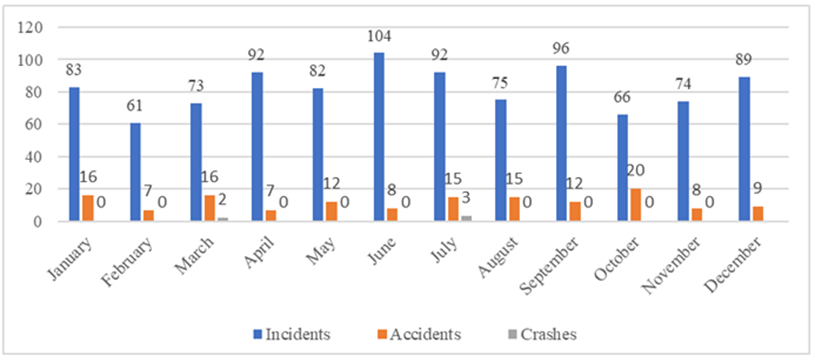
Chart 1. The distribution of aviation events by months for 2025
The primary factors
contributing to aviation incidents and accidents occurrence in 2025 are shown
on the chart (chart 2) below.
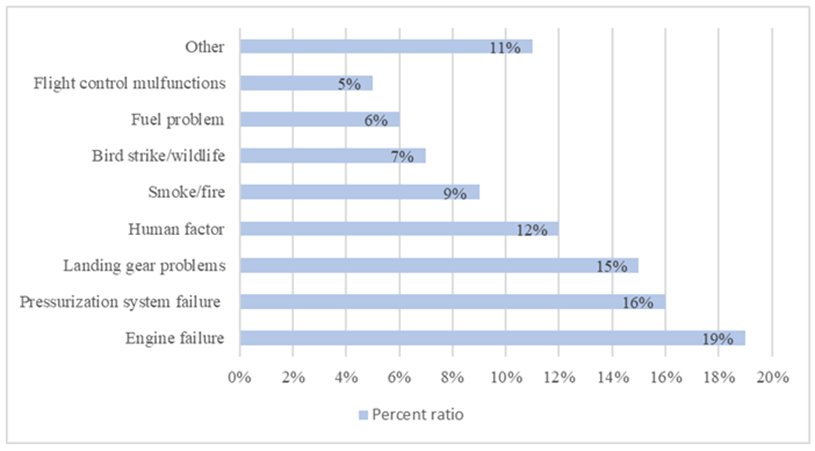
Chart 2. The
percentage ratio of aviation incidents, accidents and crashes for 2025
The data reveal four primary
categories of aviation related safety events, attributable to various system
failures and operational issues:
1. Engine failure related events
(19%). The main causes are metal fatigue, manufacturing faults, FOD ingestions.
The major consequences include forced landings, rejected take offs, fuselage
failures. Illustrative cases include: UPS MD11 at
Louisville on Nov 4th 2025, burst into flames on takeoff · Delta B763 over
Atlantic on Oct 21st 2025, engine shut down in flight · Edelweiss A343 near Jeddah
on Nov 10th 2025, engine shut down after fire indication · Spicejet
B738 near Kolkata on Nov 9th 2025, engine shut down in flight [1].
2. Pressurization system failure
related events (16%). The main causes are human errors, material fatigue, engineering
fault, failure of the aircraft pressurization system. The major consequences
are pilot’s incapacitation, health problems of passengers or crew members.
Illustrative cases include: Volaris A21N near Las Vegas on Oct 12th 2025, loss
of cabin pressure; ANZ A320 at Auckland on Nov 15th 2025, hydraulic problems ·
United B737 at Albuquerque on Jun 12th 2025, cabin pressure problems; Malaysia
B738 near Bintulu on Oct 21st 2025, loss of cabin pressure [1].
3. Human factor related events
(12%). The main causes include ATCOs and pilots
mistakes, procedural violations, interaction problems, lack of skills and
feeling fatigue. The major consequences are loss of separation, aircraft
collisions, aircraft damage. Illustrative cases include: Ryanair B738 at
Cluj on Nov 3rd 2025, first officer incapacitated; PIA A320 at Lahore on Jan
17th 2025, landed on wrong runway; ITA A339 at Los Angeles on Oct 31st 2025,
turned wrong on departure; Smartwings B38M at Marsa
Matruh on Jul 16th 2025, QNH error [1].
4. Landing
gear problems related events (15%). The main causes are bird strikes, rough
landings, structural failure, mechanical defects, foreign object damage. The
major consequences are diversions to alternate aerodromes, aborted take-offs,
passenger evacuation. Illustrative cases include: Westjet
B738 at Sint Maarten on Sep 7th 2025, main gear collapse; American B738 at
Dallas on Feb 10th 2024, overran runway on landing; Republic E175 at Boston on
Jul 14th 2025, tail strike on landing; AZAL A320 at St. Petersburg on Oct 20th
2025, landing gear problems [1].
In
conclusion, based on this analysis, the following recommendations will help to
improve flight safety and reduce the number of incidents and accidents in the
future:
1. In case of
engine failures, we suggest that personnel must provide predictive maintenance
by using vibration and oil debris monitoring (HUMS) to detect bearing fatigue
and turbine wear before critical failure occurs. Furthermore, it is important
to apply strict Foreign Object Debris (FOD) control procedures on aprons and
runways.
2. In case of
landing gear problems dual inspection protocols regarding removal of
landing gear safety pins and locks must be provided.
3. In case of
pressurisation system problem, we suggest
airlines/authorities improving immediate oxygen mask discipline by flight crew
before cabin announcements and also usage of non-destructive testing
(ultrasonic/X-ray) of door surrounding structures and window frames on
high-cycle aircraft.
4. In case of
human factor, the installations of cabin altitude warning repeaters in the
flight deck will be of much use. Pilots must be better trained to initiate
emergency descent immediately without waiting for ATC clearance.
Список литературы:
- The Aviation Herald. – Text : electronic // Avherald : [site]. – URL: https://avherald.com.
- Воронянская, Е. Л. Авиационный английский язык. Учебная тема «Безопасность на воздушном транспорте»: учебно -методическое пособие / Е. Л. Воронянская, А. Е. Чеснакова. - Ульяновск : УВАУ ГА(И), 2011. – 40 с.
- Safety reports. – Text : electronic // ICAO int : [site]. – URL: https://www.icao.int/safety-reports.
- Дежкин, В.Н. Актуальные проблемы международного воздушного права: учебное пособие / В. Н. Дежкин. – Л : ОЛАГА, 1986. - 65 с.
- Попов, М. В. Человеческий фактор в безопасности полетов. Модель SHELL / М. В. Попов. — Текст : непосредственный // Молодой ученый. — 2021. — № 31 (373). — С. 23-25.
Комментарии:


